A traditional Japanese bedroom is less a room than a daily change of use. At night, bedding is laid out on the tatami; in the morning it is folded away and the same room goes back to being a sitting room, a dining room or a place to work. The Japan Forum, a Tokyo cultural foundation, describes the futon as the main component of traditional Japanese bedding, laid out on the tatami at night and put away in the oshiire, or futon closet, each morning.
This page follows that routine: the bedding, the coverlets, the closet and the pillow. It leans on three kinds of evidence. Edward S. Morse, an American zoologist, described Japanese bedding in 1886 in a book on Japanese houses. The Japan Forum supplies modern definitions. The Metropolitan Museum’s textile records explain what a few historic pieces were for.
The bed is made on the mat
Morse put it plainly. The whole floor, he wrote, is a bed, and the bed is made upon the mats, with no bedstead, frame or marked-off area of any kind. His bed-clothes were wadded comforters spread on the floor, one or more forming the bed and another serving as the covering. The common ones were wadded with cotton, the best were silk stuffed with floss silk, and he found the heavy wadding too hot and stuffy in summer. In place of sheets, he says, a clean night-dress was provided.
The Japan Forum gives the modern vocabulary. A futon consists of a shikibuton, a quilt-like mattress, and a kakebuton, a thick-quilted bedcover. A standard shikibuton measures 90 by 195 centimeters or 100 by 210 centimeters, and kakebuton are usually 150 by 210 or 170 by 210 centimeters. Cotton wadding is widely used because it is durable, retains warmth and absorbs moisture. Covers and sheets are used for easy laundering, and airing futon in the sun keeps them comfortable and durable. The Japan Forum adds that matched sets of futon were often given as part of a bride’s dowry.
The yogi: a coverlet shaped like a kimono
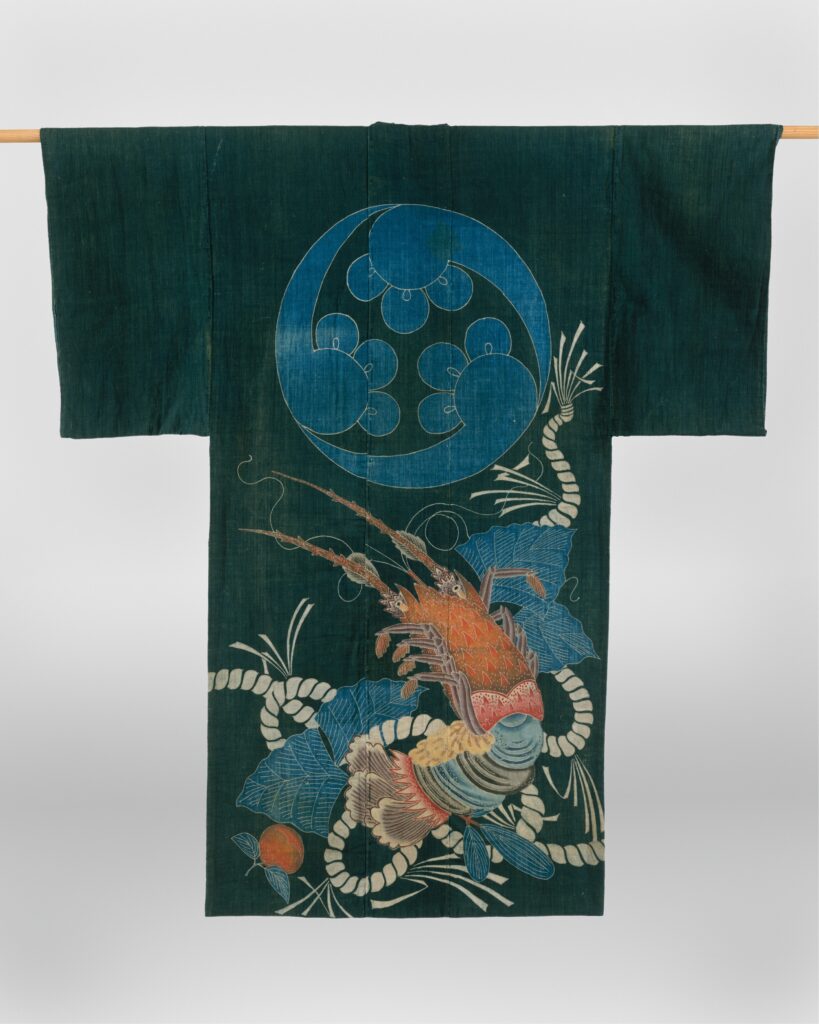
Some bedcovers were shaped like clothing. The Met describes a yogi as a thickly padded, kimono-shaped comforter used for sleeping on cold winter nights, made in three sizes. Yogi became popular in the Edo period and were frequently part of a wedding trousseau. The museum notes that ukiyo-e prints show sleepers covered with yogi, with the collar band keeping the neck and shoulders warm. Both covers and wadding would be replaced as needed, so a yogi could be used over a long period.
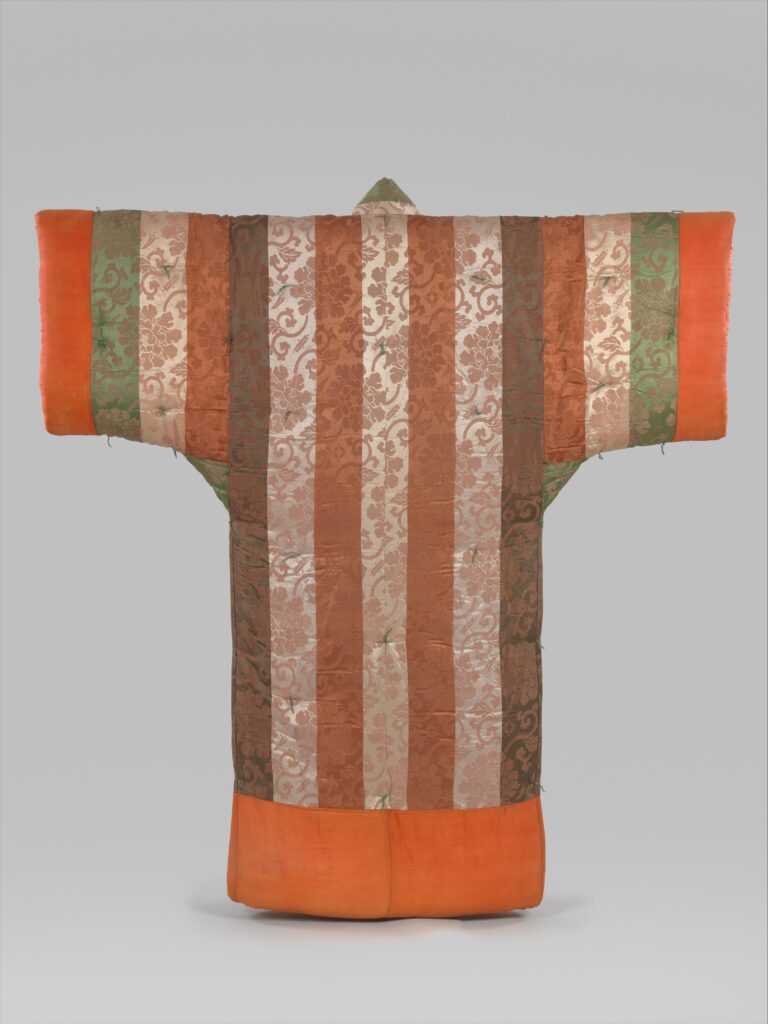
The Met’s cotton yogi at the top of this page, mid-19th century, is decorated by tsutsugaki, a freehand resist-dye method in which rice paste is squeezed from a tube onto cotton before it is dipped in indigo. The museum says such coverlets were often decorated with auspicious patterns to protect the sleeper from demons or bad dreams. The Japanese lobster, sometimes called the old man of the sea for its bent back, is a symbol of longevity that often appears on bedding, and the large design on this one may refer to New Year celebrations.
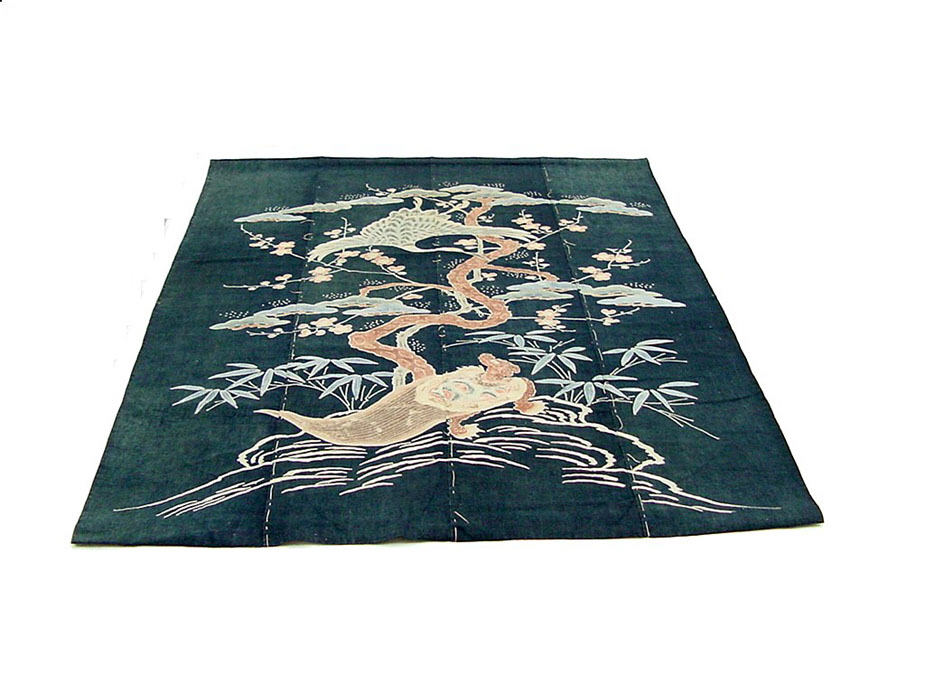
The Met also holds plain futon covers, such as this 19th-century cotton one decorated with a crane, pine and bamboo. Its record gives no more than the title, date and medium.
Where the bedding goes by day
The closet is what makes the system work. The Japan Forum describes the oshiire as a closet for futon, usually a built-in fixture of a tatami room, about one tatami mat in size and usually divided by a shelf in the middle. Morse saw the same logic from the outside. The larger closets, closed by sliding screens, were used for clothing and bedding, he says, and in a closet under the stairs he often found the bed-clothes, pillows, candlesticks and night-lamps kept together.
Because the bedding can be placed in any room, Morse noted, the absence of nearly all furniture left an uninterrupted floor, and the entire floor could be covered with sleepers if necessary. He thought this a great convenience for entertaining a crowd unexpectedly. Modern Japanese homes use beds more, the Japan Forum says, and the oshiire has become a general closet, holding small chests of drawers, hanging poles or other household things.
The pillow and the head support
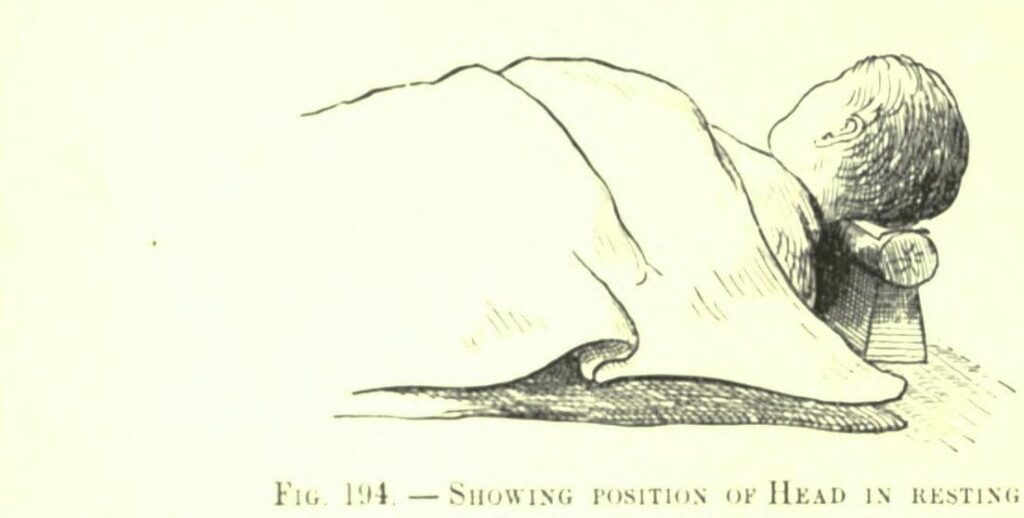
The pillow is the part Morse found hardest to like. He describes the usual makura as a light closed wooden box with a flat or slightly convex bottom, topped with a small cylindrical cushion stuffed with buckwheat hulls. The same string that ties the cushion on also holds the pillow-case, which was simply a sheet of soft paper folded several times. Other forms were hard cushions or oblong boxes with wooden ends and basketwork, porcelain ones were rare, and travellers used portable boxes with drawers for a lantern, matches, a mirror and a comb.

Pillows were arranged to support the head naturally when the shoulder rests on the floor, as in his second figure. His own first experience produced a stiff neck, and he felt through the night that he was falling off the pillow. Used to it, he saw its good points: the neck is kept free for air to circulate, and the head stays cool. He connected the form to the way hair was dressed, which for men meant the queue, and noted that some men were by then turning to softer, smaller head-rests.
A Japanese bedroom that needs very little
Morse also remarked how little work the arrangement made. In a large inn, he says, one girl could do the chamber work for the whole house: the futon were folded up and stowed, or hung over the balcony rail to air, the pillow-boxes carried downstairs, the paper pillow-cases replaced, and the room dusted for the next guests.
Beds arrived late. The Japan Forum says they became a common feature of the Japanese home only after the Second World War, and are especially popular with older people who find it easier to get in and out of one than to lie down on a futon on the floor. Some are made with a tatami platform in place of a mattress, so that futon can still be used on top.
What these sources say about the Japanese bedroom
Morse was a foreign observer in the 1880s, writing for general readers, and his view reflects that. The Japan Forum entries are short educational notes rather than research papers, and the Met’s records describe particular textiles, not every household. Together they support the routine above, not a rule for every region or period. The room itself and its other uses are covered in the tatami room guide, the wider principles in the Japanese interior design guide and the furniture in Japanese furniture, and Morse’s book belongs to the same Western curiosity about Japan described in the Japonisme guide.
Sources
- Edward S. Morse, Japanese Homes and Their Surroundings (Salem, Mass.: Peabody Academy of Science, 1886), chapter IV, “Bedding and Pillows,” pp. 210 to 213, and the passage on mats and closets in the same book. A period account by a Western observer, not modern scholarship.
- The Japan Forum (Tokyo), Deai website, Mini Encyclopedia: “Futon and beds” and “Oshiire”. Short educational entries.
- The Metropolitan Museum of Art, kimono-shaped coverlet (yogi) with lobster and crest (66.239.3); kimono-shaped comforter (yogi) with peonies and stripes (1983.566); futon cover with turtle, crane, pine, plum and bamboo (2004.559.1).