In England a bureau is a writing desk. In America it can just as well be a low chest of drawers in a bedroom, and Merriam-Webster lists both. The French word it comes from meant a desk and also the cloth that covered one, and goes back to an Old French word for a woolen fabric. A piece of furniture named after its tablecloth is a fair warning for anyone shopping for a French writing desk: the names have never held still, and neither has the furniture.
The French writing desk comes in three main forms: the desk that folded, the desk that did not, and the desk that closed up like a cupboard.
The broken desk
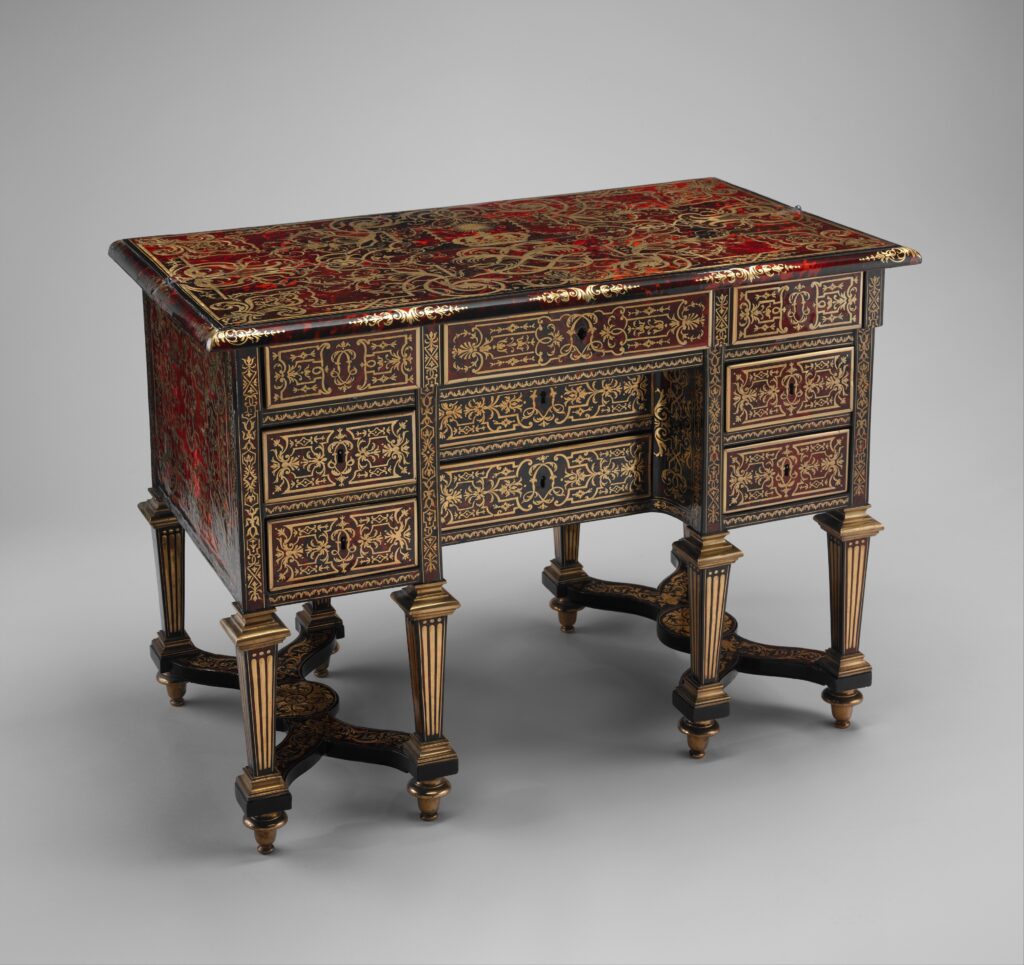
The Met calls the bureau brisé, literally the “broken desk”, a small writing table whose folding top lifts to reveal a narrow writing surface. It appeared about 1669 and stayed fashionable until the early eighteenth century, when it gave way to the flat-topped bureau plat, which the museum calls more practical. Its own example, about 1685, was one of two almost identical desks commissioned for Louis XIV’s Petit Cabinet at Versailles, and is one of the few surviving pieces made for the king’s personal use. It is covered in Boulle work, marquetry of tortoiseshell and engraved brass.
The flat top wins
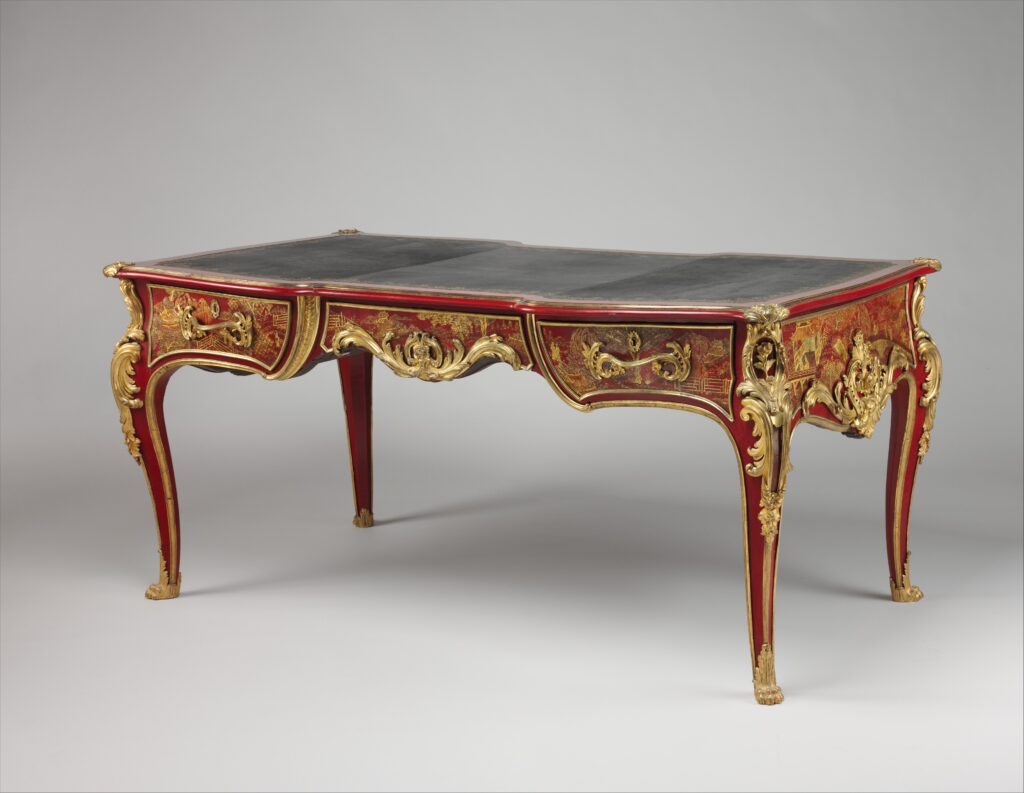
The bureau plat is the classic of the group. It is a flat-topped table with drawers under the top and nothing above it to get in the way. The Met’s example by Gilles Joubert was supplied on December 29, 1759 for Louis XV’s Cabinet Intérieur at Versailles. It is lacquered crimson with gold landscapes in imitation of Chinese lacquer, then fashionable, and its flat top was originally lined with black velvet, so that the king and his ministers could spread out documents and unfold maps.
That top is now lined with modern leather, a fitting fate for a desk named after a cloth. The table stayed in the room under Louis XVI until December 1786, when a marquetry writing table by Guillaume Benneman replaced it. Even a king’s study got refurnished.
By the 1780s the shape had changed even where the idea had not. The Met’s bureau plat by Jean-François Leleu, about 1780, trades the curving legs of the earlier tables for tapering, architectural ones, in what the museum calls the strong, masculine forms he favored, which is Neoclassical taste as the Louis XVI furniture guide describes it. His patrons included the prince de Condé. Leleu trained alongside Jean-Henri Riesener in the workshop of Jean-François Oeben, and the Met notes that a similar table appears in the 1808 portrait of Talleyrand. Earlier, the signed bureau plat by Bernard II van Risenburgh, about 1750, uses satiné wood for an effect the Met compares to watered silk.
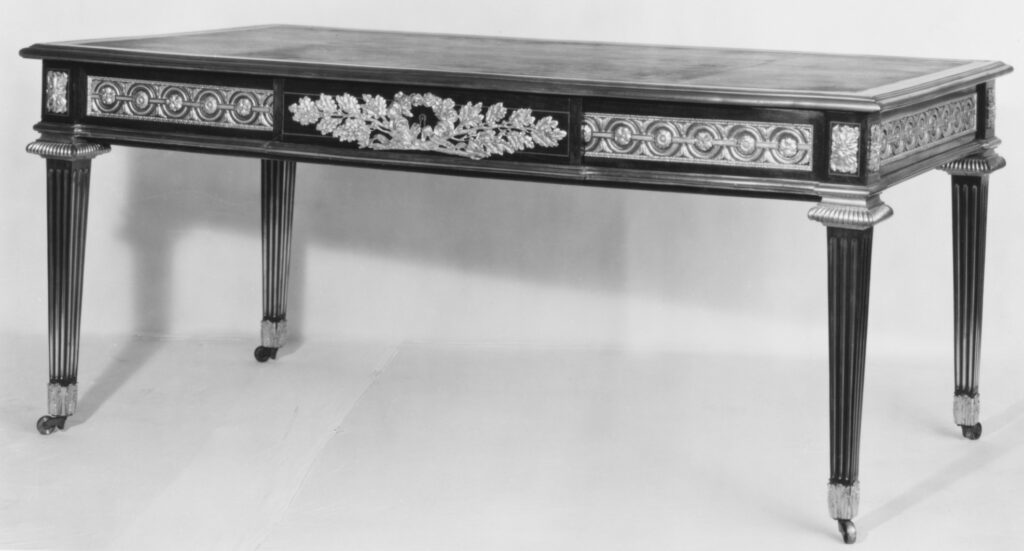
One thing the photographs flatter: these are big pieces. The three Met bureaux plats described here measure about 54 1/2 inches wide at the smallest and nearly 70 at the largest. A bureau plat is a table you give a room to, not a desk you squeeze into a corner, and the Louis XV furniture guide shows the style that produced the curved ones.
The desk that closed
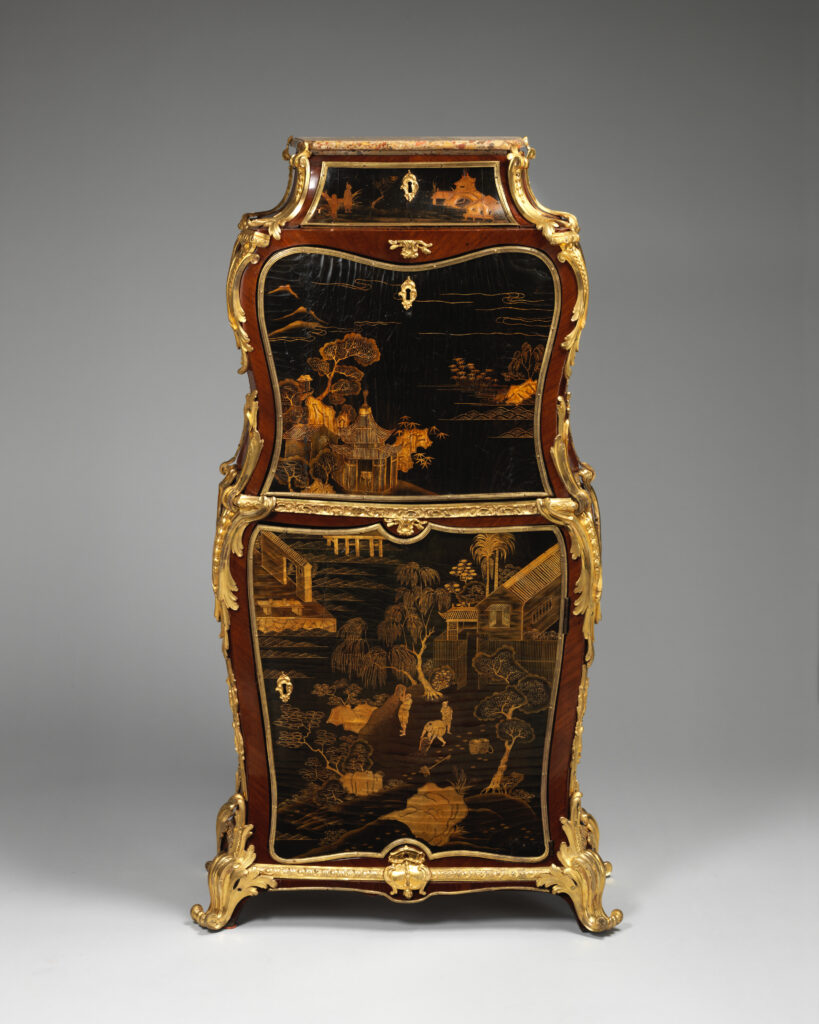
The third form hides its writing surface. The Met’s drop-front secretaire (secrétaire à abattant) by Jean-François Dubut, about 1760, is partly covered in Chinese lacquer, and once the fall front is opened it reveals a series of drawers with geometric marquetry. The museum reads its small size as a sign that it belonged in one of the more intimate rooms, where the owner could write undisturbed. It is the kind of desk that leaves nothing out on show, which is a virtue in a drawing room and a disappointment when you are looking for the pen.
Honest copies and unhelpful impostors
The same Dubut record carries two sentences worth reading twice. The model, the museum says, remained very popular and was repeated a number of times in the nineteenth and twentieth centuries, and most of the mounts on this one have been replaced. A good model gets copied and a good desk gets repaired, which is why the questions that matter are what is original, what was replaced and whether the seller says so.
A different problem comes from the other side of the Atlantic. From the 1950s into the 1970s, American manufacturers sold French Provincial furniture as a style in its own right, in matching suites, and a desk from a bedroom set is an American factory piece, not a French period one. When this keyword was researched, several of the top search results for a French writing desk were exactly that kind of mid-century desk. The guide to French Provincial furniture explains the two meanings of the name and the quick signs of factory work: veneered panels, plywood backs and drawer bottoms, moulded decoration standing in for carving.
Before you buy a French writing desk
Measure before anything else. Then look at what covers the top: a replaced leather or velvet surface is common, the Met’s Joubert has modern leather, and it should be stated in the description. Mounts deserve the same question the Dubut desk answers for itself, and the guide to ormolu and gilt bronze explains how to read them. Parisian furniture offered for sale was supposed to carry a maker’s stamp from 1743, though the Louis XV guide is careful to say that a missing stamp settles nothing. The wider points on drawers, repairs and prices are in the buying vintage furniture guide.
The desk has two large relatives in the French room, the commode and the armoire, and all three sit in the sequence laid out in the timeline of French furniture styles. All three are large, and none of them forgives a measurement taken after the purchase.
Sources
- Merriam-Webster, bureau
- The Metropolitan Museum of Art collection records: Small desk with folding top (bureau brisé), 1986.365.3, Writing table (bureau plat), Gilles Joubert, 1973.315.1, Writing table (bureau plat), Jean-François Leleu, 1972.284.6, Writing table (bureau plat), Bernard II van Risenburgh, 1974.356.186 and Drop-front secretaire, Jean-François Dubut, 2019.283.3a, b
- Patina Journal, French Provincial furniture, for the American factory style and its signs